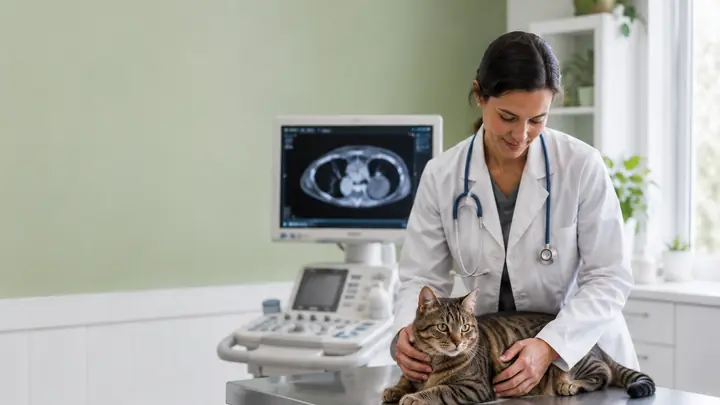
Illustrative image for Cat X-Ray Cost in Los Angeles.
Supportive Care for Vet Visits & Mobility
These PawPulse products support general wellness, mobility and calmer routines around veterinary visits.
Support calmer vet-visit routines. Supportive product only; not a substitute for veterinary diagnosis or treatment.
View Calming Powder ↗Explore omega support. Supportive product only; not a substitute for veterinary diagnosis or treatment.
View Omega Supplement Oil ↗Explore joint support. Supportive product only; not a substitute for veterinary diagnosis or treatment.
View Joint Supplement Oil ↗What changes the cost?
For diagnostic imaging, compare the number of views or scan scope, sedation, specialist interpretation and whether additional tests are likely.
Hospital capability, whether advanced diagnostics are available on site, whether referral is needed, after-hours timing and the number of return visits can all affect the total.
How to compare two veterinary estimates
| Compare | Why it matters |
|---|---|
| Exam and diagnostics | Check whether the estimate includes the workup needed before treatment. |
| Sedation or anesthesia | Ask what monitoring, airway management and recovery support are included. |
| Procedure scope | Confirm whether the estimate covers the full treatment or only the core procedure. |
| Hospitalization | Ask whether overnight care, repeat tests or ICU-level monitoring could be added. |
| Follow-up | Confirm which rechecks, imaging or medication reviews are included. |
Los Angeles planning considerations
Los Angeles offers a broad mix of general practices, specialty centers and emergency hospitals, but travel time across the metro can matter. For planned procedures, compare what each facility can complete in-house and how many return visits are expected.
For planned care, ask whether the full pathway can be completed in one hospital. For urgent care, realistic drive time and capability should outweigh convenience or a lower quote farther away.
Questions to ask
- What is included in the low-to-high estimate?
- Which services are definitely required and which depend on findings?
- Could a specialist or referral hospital be needed?
- Are medications, repeat testing and rechecks included?
- What would make the total move toward the high end?
National guide
See the national Cat X-Ray Cost guide for procedure-level context.
Local access and referral realities
Los Angeles's size and traffic patterns mean travel time can become part of the treatment decision, particularly when a specialty or emergency hospital is across the metro.
For planned care, owners can usually compare several hospitals, but estimates should be normalized for diagnostics, anesthesia, medications, hospitalization and follow-up.
Sedation and positioning
Cats may tolerate some radiographs awake, but pain, stress or the need for exact positioning can make sedation appropriate. This can add cost but may improve image quality and reduce repeated exposures.
When other imaging is recommended
X-rays are useful for many problems but do not show every soft-tissue condition clearly. The veterinarian may recommend ultrasound or other imaging if radiographs do not answer the clinical question. Ask whether the estimate is for the first diagnostic step or the likely full imaging pathway.
What to confirm before approving the estimate
- Ask whether the estimate is a fixed quote or a low-to-high range.
- Confirm which diagnostics are already included and which may be added later.
- Ask whether medications, interpretation fees, anesthesia monitoring and rechecks are included.
- Find out what clinical findings could make the procedure more complex.
- Ask whether a specialist or referral hospital could become necessary.
- Confirm what follow-up care can be done with your regular veterinarian.
Insurance, payment and timing considerations
Pet insurance, if already in force and applicable to the condition, may reimburse part of eligible veterinary expenses according to the policy's deductible, reimbursement percentage, exclusions and waiting periods. PawPulse Reviews does not determine coverage. Owners should check policy terms directly with the insurer. For uninsured planned care, some hospitals may discuss staged diagnostics, third-party financing or payment options, but availability differs by provider.
Timing matters too. Planned procedures may allow time to compare written estimates, while emergency conditions may not. If the veterinarian says delay could worsen the outcome, the safest comparison is often between the care that can be delivered now rather than hypothetical cheaper care elsewhere.
Stress and handling considerations
Cats can become stressed in unfamiliar environments, which can affect positioning and the need for sedation. Bringing the cat in a secure carrier and following pre-visit instructions can make the appointment smoother. Ask whether calming medication is ever recommended before a scheduled imaging visit.
Keep a copy of the written estimate and discharge or treatment instructions. If the plan changes, ask the hospital to explain what changed clinically and which new services are being added. That makes it easier to distinguish necessary care from optional convenience items and gives you a clearer record for insurance reimbursement when applicable.
For planned care in the Los Angeles metro, ask whether diagnostics, treatment and follow-up can be completed in one facility. If referral is possible, confirm where the pet would go, how records are transferred and whether repeat visits can return to the primary veterinarian.
Los Angeles has a very large veterinary market, but travel time can vary sharply by neighborhood and time of day. For urgent care, practical drive time matters alongside hospital capability.
For this treatment specifically, ask the veterinarian what must happen at the current facility and what might trigger referral. Confirm whether prior bloodwork or imaging will be accepted, whether transfer requires a second examination, and how follow-up can be coordinated after the main procedure or diagnostic visit. Those questions often reveal practical differences that a headline price does not show.
For Los Angeles owners, geography is part of the care decision. A hospital that looks close on a map may still be a difficult trip during heavy traffic, so urgent-care planning should use realistic travel time rather than straight-line distance. For planned surgery or advanced imaging, the larger metro can be an advantage because owners may have more than one referral option. That makes it worthwhile to compare who performs the procedure, which diagnostics are available on site, whether overnight monitoring is provided and how many return visits are expected. If a treatment requires several rechecks, rehabilitation sessions or repeat imaging, location can affect the practical cost even when the quoted medical fee is similar.
Los Angeles access, referral and travel considerations
Frequently asked questions
What affects cat x-ray cost in atlanta, ga in Los Angeles?
The total depends on diagnosis, diagnostics, clinician involvement, sedation or anesthesia, procedure complexity, medications, hospitalization and follow-up.
Why can two veterinary estimates be very different?
Hospitals may include different services. One quote may bundle diagnostics, monitoring and rechecks while another lists them separately.
Should I ask for a low-to-high estimate?
Yes. A range can show what is expected and what could be added if the clinical situation changes.
Are diagnostics usually included?
Not always. Ask whether exam fees, bloodwork, imaging and specialist interpretation are included or billed separately.
Can anesthesia or sedation be separate?
Yes. Ask what monitoring, airway management, medications and recovery support are included.
Are medications and follow-up included?
Sometimes. Confirm take-home medications, rechecks, repeat imaging and laboratory testing before comparing estimates.
Should I compare multiple hospitals?
For planned care, comparing equivalent itemized estimates can be useful. For urgent care, capability and time to treatment matter more.
Does emergency timing increase the bill?
It can because after-hours staffing, urgent stabilization and intensive monitoring require additional resources.
Can pet insurance help?
If the condition is eligible under an existing policy, reimbursement may help. Coverage depends on deductibles, exclusions and policy terms.
Are PawPulse products a substitute for veterinary care?
No. Product CTAs are supportive-care links only and do not replace diagnosis, surgery, emergency care or prescription treatment.
When should I seek care immediately?
Breathing difficulty, collapse, major trauma, uncontrolled bleeding, poisoning and inability to urinate need prompt veterinary attention.
Where can I read the national treatment guide?
Each city page links to its national PawPulse Reviews parent guide for broader treatment and cost context.