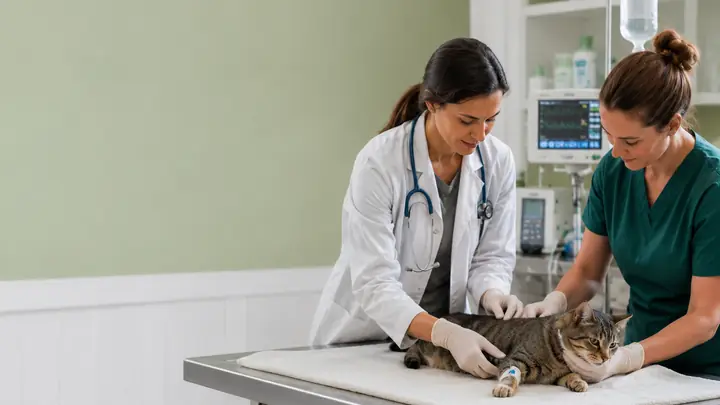
Illustrative image for Cat Urinary Blockage Treatment Cost in Nashville.
Supportive Urinary & Wellness Options
These products are for routine supportive care only. A urinary blockage is an emergency and requires immediate veterinary treatment.
Routine urinary support. Emergency veterinary care comes first.
View Pet Urinary Support ↗Support calmer daily routines. Emergency veterinary care comes first.
View Calming Powder ↗Explore omega support. Emergency veterinary care comes first.
View Omega Supplement Oil ↗What changes the cost?
For urinary blockage, treatment speed matters more than price shopping because inability to urinate can become life-threatening.
Hospital capability, whether advanced diagnostics are available on site, whether referral is needed, after-hours timing and the number of return visits can all affect the total.
How to compare two veterinary estimates
| Compare | Why it matters |
|---|---|
| Exam and diagnostics | Check whether the estimate includes the workup needed before treatment. |
| Sedation or anesthesia | Ask what monitoring, airway management and recovery support are included. |
| Procedure scope | Confirm whether the estimate covers the full treatment or only the core procedure. |
| Hospitalization | Ask whether overnight care, repeat tests or ICU-level monitoring could be added. |
| Follow-up | Confirm which rechecks, imaging or medication reviews are included. |
Nashville planning considerations
Nashville has a substantial veterinary market with access to emergency and specialty care, but cross-metro traffic can matter in urgent situations. For planned treatment, compare scheduling, capability and follow-up logistics.
For planned care, ask whether the full pathway can be completed in one hospital. For urgent care, realistic drive time and capability should outweigh convenience or a lower quote farther away.
Questions to ask
- What is included in the low-to-high estimate?
- Which services are definitely required and which depend on findings?
- Could a specialist or referral hospital be needed?
- Are medications, repeat testing and rechecks included?
- What would make the total move toward the high end?
National guide
See the national Cat Urinary Blockage Treatment Cost guide for procedure-level context.
Local access and referral realities
Nashville has substantial primary, emergency and specialty veterinary capacity, but cross-metro traffic can matter when a pet is unstable.
For planned treatment, owners can often compare more than one hospital, making itemized estimates especially valuable.
Why obstruction treatment becomes expensive quickly
A blocked cat often needs more than catheter placement. Bloodwork may reveal dangerous potassium changes or kidney stress, while IV fluids, pain medication, sedation, urinary catheter care and hospitalization may be required. Repeat laboratory tests are common because the team needs to know whether the cat is stabilizing.
Re-blocking and longer hospitalization
Some cats re-block after the catheter is removed or need longer monitoring. That can extend hospitalization and increase the bill. In recurrent cases, the veterinarian may discuss additional diagnostics, diet changes or surgery. Because obstruction can become life-threatening, cost comparison should happen only after the cat is receiving appropriate care.
What to confirm before approving the estimate
- Ask whether the estimate is a fixed quote or a low-to-high range.
- Confirm which diagnostics are already included and which may be added later.
- Ask whether medications, interpretation fees, anesthesia monitoring and rechecks are included.
- Find out what clinical findings could make the procedure more complex.
- Ask whether a specialist or referral hospital could become necessary.
- Confirm what follow-up care can be done with your regular veterinarian.
Insurance, payment and timing considerations
Pet insurance, if already in force and applicable to the condition, may reimburse part of eligible veterinary expenses according to the policy's deductible, reimbursement percentage, exclusions and waiting periods. PawPulse Reviews does not determine coverage. Owners should check policy terms directly with the insurer. For uninsured planned care, some hospitals may discuss staged diagnostics, third-party financing or payment options, but availability differs by provider.
Timing matters too. Planned procedures may allow time to compare written estimates, while emergency conditions may not. If the veterinarian says delay could worsen the outcome, the safest comparison is often between the care that can be delivered now rather than hypothetical cheaper care elsewhere.
Discharge and recurrence planning
Before discharge, owners should understand litter-box monitoring, medication instructions, diet recommendations and the warning signs of re-obstruction. A cat that begins repeated straining, vocalizing or producing little to no urine after discharge needs prompt veterinary reassessment.
Keep a copy of the written estimate and discharge or treatment instructions. If the plan changes, ask the hospital to explain what changed clinically and which new services are being added. That makes it easier to distinguish necessary care from optional convenience items and gives you a clearer record for insurance reimbursement when applicable.
Frequently asked questions
What affects cat urinary blockage treatment cost in nashville, tn in Nashville?
The total depends on diagnosis, diagnostics, clinician involvement, sedation or anesthesia, procedure complexity, medications, hospitalization and follow-up.
Why can two veterinary estimates be very different?
Hospitals may include different services. One quote may bundle diagnostics, monitoring and rechecks while another lists them separately.
Should I ask for a low-to-high estimate?
Yes. A range can show what is expected and what could be added if the clinical situation changes.
Are diagnostics usually included?
Not always. Ask whether exam fees, bloodwork, imaging and specialist interpretation are included or billed separately.
Can anesthesia or sedation be separate?
Yes. Ask what monitoring, airway management, medications and recovery support are included.
Are medications and follow-up included?
Sometimes. Confirm take-home medications, rechecks, repeat imaging and laboratory testing before comparing estimates.
Should I delay treatment to compare prices?
No. If the condition is an emergency, stabilize the pet first. Cost questions can be discussed during or after initial stabilization.
Does emergency timing increase the bill?
It can because after-hours staffing, urgent stabilization and intensive monitoring require additional resources.
Can pet insurance help?
If the condition is eligible under an existing policy, reimbursement may help. Coverage depends on deductibles, exclusions and policy terms.
Are PawPulse products a substitute for veterinary care?
No. Product CTAs are supportive-care links only and do not replace diagnosis, surgery, emergency care or prescription treatment.
When should I seek care immediately?
Breathing difficulty, collapse, major trauma, uncontrolled bleeding, poisoning and inability to urinate need prompt veterinary attention.
Where can I read the national treatment guide?
Each city page links to its national PawPulse Reviews parent guide for broader treatment and cost context.
Methodology
We do not invent clinic-specific prices, ratings or provider lists. See our methodology.